Roll Me Away
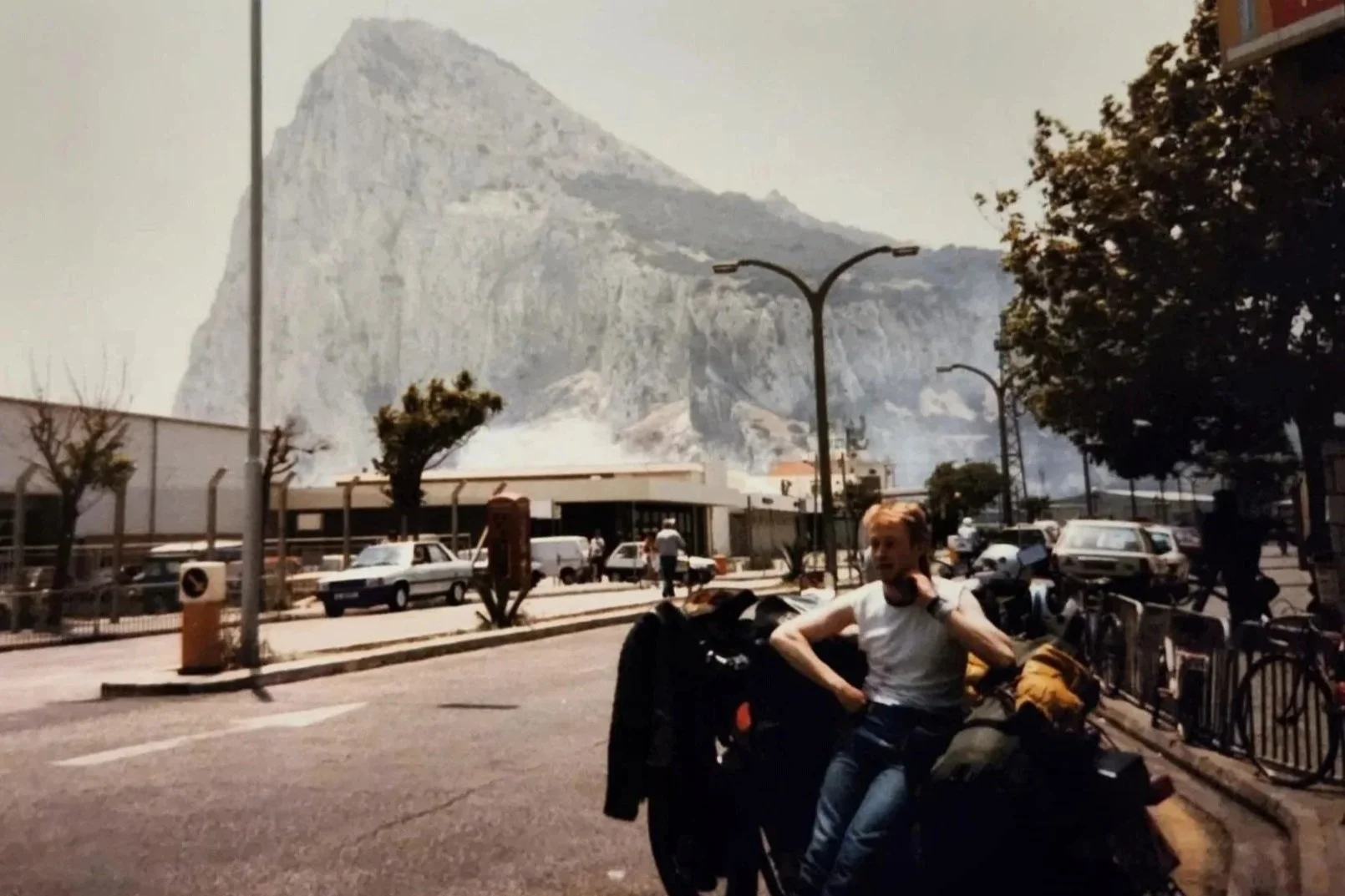
I was born and grew up on the east coast of England, UK, by the sea, in the 1960s and 70s. We lived in a rural ‘hamlet’ of about 20 (mostly) ‘council houses’. My father, a carpenter on building sites, died of MND when I was 6 years old. My mother left school at age 13. She was very bright, reading the bible to her grandfather when she was very young. Her first work was in ‘service’ as a live-in maid. Later on she worked in a grocery shop, then part-time as a school ‘dinner lady’, and spent the last years of her working life in a hospital laundry room. My step-father was a driver in the Army, then at a local brewery. My route to an academic career in philosophy was punctuated by key ‘forking path’ junctures, huge helpings of good luck (cf. Carol Hay’s post), and a stable, supportive and loving family (also my good luck of course).
At age 11, along with every student of that age, I took the ‘11+’ IQ test to determine whether I would go to a ‘grammar’ or ‘secondary modern’ school. Grammar schools were for ‘academically able’ students, and secondary modern schools were to impart life-skills and preparation for non-professional work. This was the British ‘tripartite education’ system, which also included ‘technical schools’, though very few of these ever came into operation. Philosophers will immediately recognise the Platonic gold-silver-bronze classificatory rationale to the system. I, along with (as I recall) all but one in my year, failed the 11+ so went to the local secondary modern school. (See Graham Priest’s post – he was, he says, ‘one of the lucky ones’ who got to a grammar school; my luck kicked in at later stages.) I left school at 16 with a handful of ‘CSE’ (Certificate of Secondary Education) exams that included Art & Craft and Home Economics (cookery). At that time I had never met anyone that had been to university.
My first job was on a local mink (fur) farm, a job I’d done since age 14 at weekends. I then got a better job in the office of a road haulage company, but this only lasted for a year due to its closure (it was here that I met my very first university graduate – a strangely aloof and learned young man, who was on a work placement and didn’t fit in at all). I immediately got another job at a famous turkey meat processing factory (those were the days of full employment). I worked here for nearly 7 years, some of those years on alternating 06.00-14.00 / 14.00-22.00 shifts. I hated it. I felt trapped, doing mindless, meaningless, work. The only times that I was happy were weekends and holidays, and even those were marred by the dread of returning to work (Marx on alienated labour: ‘The worker…only feels himself outside his work, and in his work feels outside himself. He feels at home when he is not working, and when he is working he does not feel at home’). With hindsight, I was pretty badly depressed over those years.
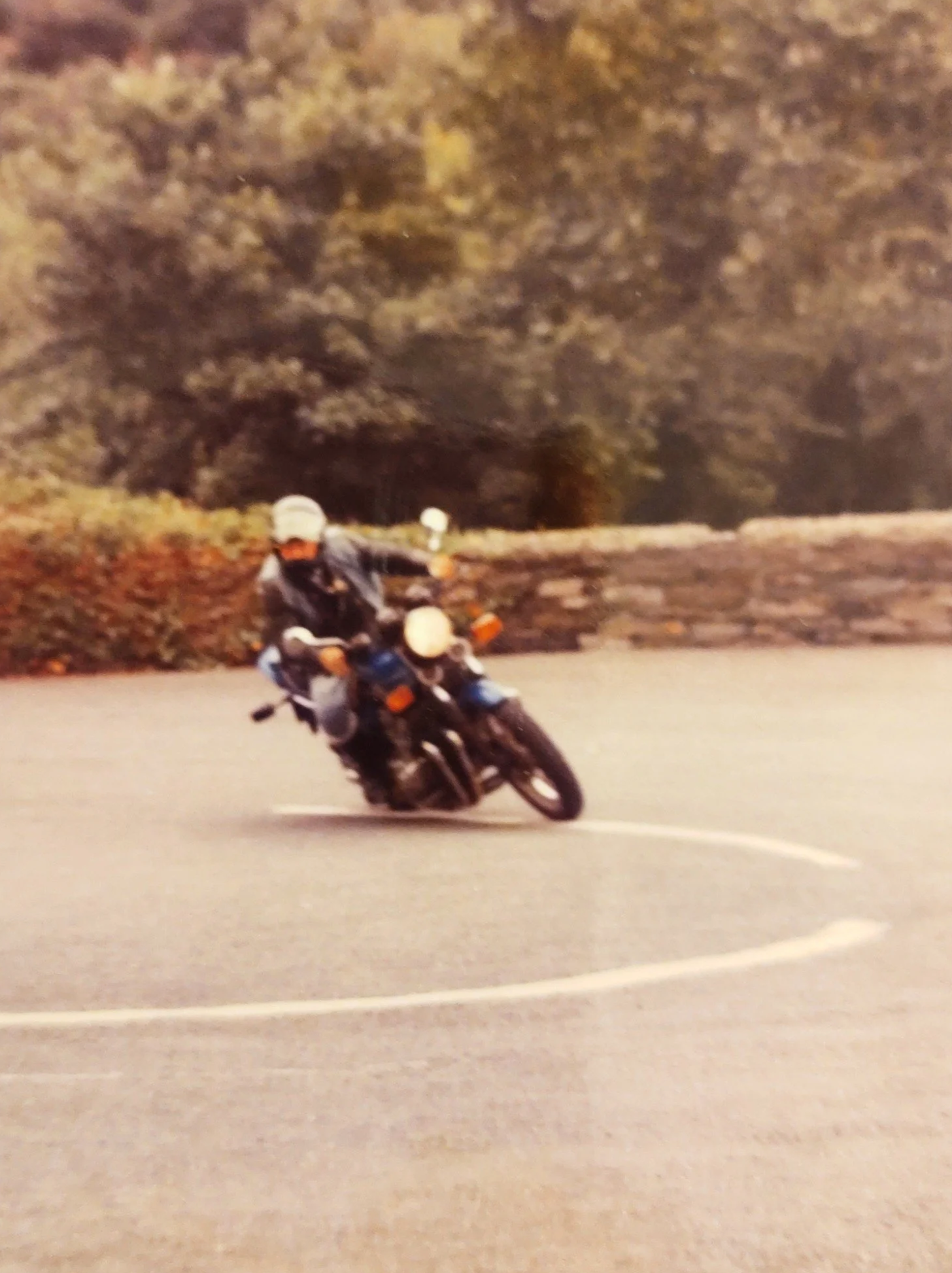
There was one thing that did give me happiness, thrills and purpose, albeit very nearly killing me: motorcycling. I got my first bike at 16 – a fairly moderate 50cc ‘learner’ machine. At 17, thanks to being in full-time employment, I upgraded to a second-hand Suzuki 250cc X7, proudly advertised at the time as the world’s first 100mph ‘learner’ bike (no test or training required). One year later I had a bad crash, hitting a car that turned across my path at 60mph, which put me in hospital, on my back in traction for 8 weeks. As soon as I’d recovered and learnt to walk again, I bought a grown-up second-hand 650cc machine with the insurance compensation money, and soon after graduated to very fast 900cc machines, on which I travelled all over Europe in my summer holidays.
I had a recurring fantasy on my daily 10-mile ride to work. With Bob Segar’s ‘Roll Me Away’ playing in my head as I approached the factory drive, I’d think: one day, I won't slow down, I’ll open the throttle and just keep going, and going, and see where I end up. But realistically I could see no way out of the trap. I applied for a few better jobs, but without proper qualifications got nowhere. Then, in my mid-20s, inspired by my older sister taking and passing A-level English Literature via evening class, I decided to study for Maths O-level (the qualification you’d get at grammar school at 16) at evening class, after work, hoping that this would help me to the promised land of a better job. I managed to get grade C, which counts as a pass, and I was greatly chuffed by this success, so the following year started an A-level sociology evening class (A-levels are 2-year post-16 academic qualifications). This was a game-changer – I loved it, encountering intoxicating radical ideas such as arguments for ‘the abolition of the family’. Never in my life had I any inkling that such thoughts could arise and be spoken/written! At the very beginning of my studies I resolved that because I was encountering so many words I’d never heard of I wouldn’t just pass over them, but look them up in the dictionary. This made reading slow and laborious, but stood me in good stead later. It transpired that not only did I love sociology, but also seemed to be pretty good at it. It was during this year that I came upon my first momentous forking path juncture.
Two things came to my attention: (i) the factory advertised a stock-supervisor job in the cold store, which would be a substantial promotion, more money, and prestige; and (ii) I discovered there were Local Education Authority ‘discretionary’ grants for ‘mature students’ to study A-levels full-time. This represented a forked path of alternative possible futures: the central path being continuation with the status quo if neither (i) nor (ii) were taken. In my preference structure (i) and (ii) were equally valued; continuation was highly disvalued. So I resolved to apply for the supervisor job, and if offered I’d happily take it, but if not I’d divert onto the study path. My first large helping of luck was that I didn’t get the supervisor job, so it was already decided that I’d take the grant. It wasn’t an easy decision to enact – giving up a decently paid job (relative to my social class and geography) looked reckless, and I was assailed by many questions of the form ‘but what will you do after the A-levels?’, and I needed my family to waive my household financial contribution, which they willingly did. At this point on the beginning of my new path I had no thoughts of university – my intention was to see if I could become a social worker, or, armed with three A-levels, have a better chance of getting one of those ‘good jobs’ I’d long dreamed of. Handing in my resignation and leaving the factory on my last day of work remains the most extraordinarily delectable and exhilarating act of liberation – my fantasy of riding past those factory gates, for ever, was realised.
Philosophy came to my attention on the 6th September 1987, right at the beginning of my full-time A-level study in Sociology, English Literature, and Psychology. It did so via the wonderful BBC TV series The Great Philosophers, in which Bryan Magee dialogues with leading contemporary philosophers on the ideas of the historically great philosophers, beginning with Myles Burnyeat on Plato and Socrates, and ending with John Searle on Wittgenstein. I didn’t fully understand what they were talking about, but understood just enough to realise its importance and that I wanted to understand more. By the time I’d decided I wanted to continue study, at university, philosophy was to be my main subject.
After 2 years of successful A-level study and high grades I was off to the university of Bristol, as a 26-year-old mature student. Back then, all university fees were paid by one’s Education Authority, including a reasonably healthy maintenance grant – indeed, I qualified for an extra increment due to my mature student status. At first I had no thoughts about post-graduate study, but from around the second year I aspired to go further. Towards the end of my third year I was accepted onto a taught MPhil at the University of Cambridge. Wonderful! But, I could only do it with the award of a UK Research Council studentship. Without that funding I simply couldn’t afford it. The results of that competition came in the summer, and I was unsuccessful. But, I had been placed on a reserve list, the result of which would be revealed in September. I was, presumably, dependent on a successful candidate pulling out and me being high enough up on the list to inherit their place. This was my second momentous forking path juncture, though this one had only two directions: continuation in the brewery warehouse job I’d had for the previous 3 summer vacations and which was now on offer on a permanent basis (my step-father worked at the brewery and got me the job there); or the postgraduate study path. I lucked out again, finding out in September that I’d been called up from the reserve list and was off to Cambridge within a month. The rest was relatively plain sailing along the academic waterway. I received another Research Council studentship for my PhD – which I strongly suspect was not such a feat with a Cambridge MPhil under my belt. 10 years after leaving my factory job I landed a permanent lectureship at the University of Exeter (the first post I applied for), where I remain to this day, currently as Senior Lecturer in Philosophy.
My non-academic background has left me unspeakably grateful for the luck that has given me a career wherein I am able to be at home (in the non-alienated labour sense) when I’m at work. I’m certainly as prone as the next academic to bemoaning the trials and tribulations of contemporary university life – but when I reflect on what the pre-academic world of work and education was like compared to the academic one I transitioned into, my good fortune smacks me in the face.
My biographical starting point, location and experience has undoubtedly influenced the kinds of issues I’ve found myself drawn to wanting to examine philosophically. These consist in the myriad ways in which our – everyone’s – personal agency, moral knowledge, and moral psychology are deeply embedded in and entwined with our social, institutional, and historical conditions of existence. If there is anything biographically distinctive to my philosophical practice, I’d like to think it comes from a heightened sense both that things could be otherwise, but that how to make them otherwise is neither obvious nor easy.

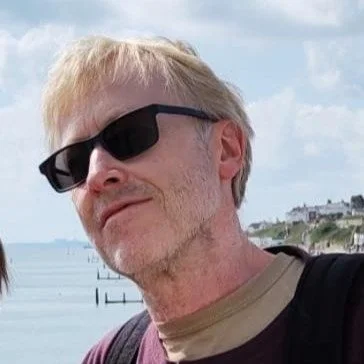
Nigel Pleasants is Senior Lecturer in Philosophy at the University of Exeter.
Published 3 August 2026