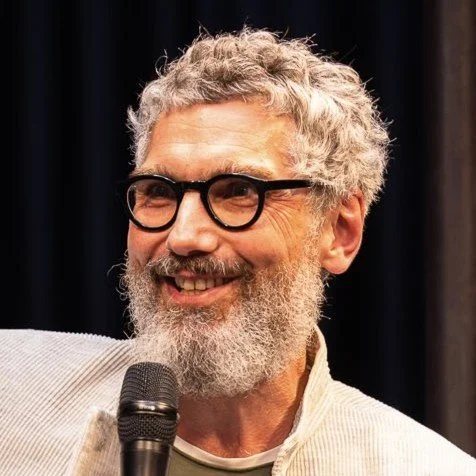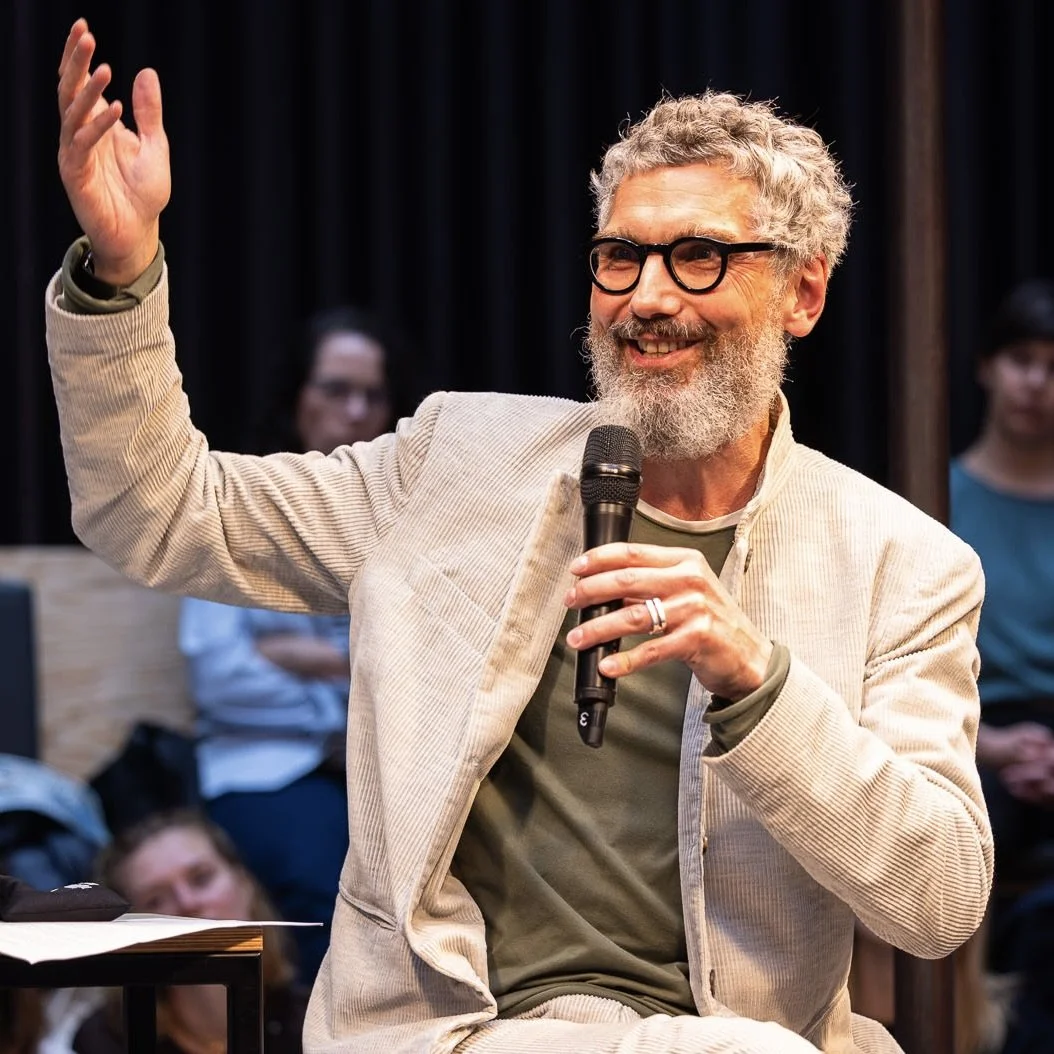
Markus Schrenk. Photo © Nadine Zilliges
My parents were very young, 17 and 19, and still at school when I was born. My mother became a nursery school teacher, my father a tax inspector. We lived in a village in Rhineland-Palatinate, Germany, where cultural offerings were scarce and my high school was more or less the only gateway to education, culture, and science. Fortunately, I had like-minded friends who shared my interest in philosophy and science, and teachers who nurtured it. My parents never put obstacles in my way, and where they could, they cleared some for me.
During my formative years, I immersed myself in popular science literature by luminaries such as Bertrand Russell, Werner Heisenberg, and Ernst Gombrich. Heisenberg’s recollected conversations with Bohr, Einstein and Pauli, in particular, awakened in me a longing for similar intellectual exchanges. I can still recommend Russell’s The Problems of Philosophy, Heisenberg’s Physics and Beyond: Encounters and Conversations and Gombrich’s The Story of Art; at least the latter must, of course, be supplemented by Katy Hessel’s The Story of Art Without Men.
Yet the path to becoming a researcher seemed shrouded in mystery; academia felt like a distant realm. Looking back, I think professors existed for me as figures almost of imagination. I perceived entry into that world a little like joining a religious order, reserved for those who had completed their doctorates. University and research seemed to echo something like Hermann Hesse's Glass Bead Game, a book in which Hesse describes the quasi-monastic life of an elite secular order of scholars who devote themselves to a contemplative play that weaves mathematics, music, philosophy and the arts into a single synthesis of humanity’s intellectual and cultural heritage. Heisenberg and others, in their popular writings, sometimes encourage exactly that impression about university. Academic reality turned out to be much different, but those moments do exist, when philosophy lets me see the sciences, the arts and life itself as parts of one larger conversation.
It wasn't until later that I fully grasped the differences between myself and many peers from academic backgrounds, a disparity illuminated by class habitus, a term, I learned, Pierre Bourdieu introduced for the dispositions shared by people formed under similar class conditions. Class shapes values, relationships, and lifestyles invisibly: status is signalled through “secret codes” – cultural goods, consumption patterns, forms of economic, cultural, and social capital – and this often happens without those affected noticing, reinforcing group bonds that hinder mobility.
(Rereading the last paragraphs, I notice I have just name-dropped Russell, Heisenberg, Hesse, Gombrich, Hessel and Bourdieu in quick succession, a fine display of the very codes I’m describing. Converts are always the most zealous.)
University itself felt inclusive. In the seminar room, analytic philosophy has always struck me as commendably egalitarian. But outside lecture halls, the differences were stark. In many academic households, cultural references are handled more naturally; people have travelled extensively, speak several languages, eat out more frequently and adventurously. This was, at times, intimidating. Naivety helped me more than I realised: it took time to explicitly understand the source of the alienation I occasionally felt. By then, fortunately, I had achieved some academic success and could usually cope, though not always. There were moments when confidence in having “made it” gave way to feelings of total inadequacy. Predictably, this happened especially when academic setbacks (e.g., a harshly criticised thesis chapter) were immediately followed by, say, a fellow student’s casual aside about an opera production or a novel that everyone in the room seemed to know.
These “secret codes” extend beyond what one owns to what one takes for granted: familiarity with opera, literature, or culinary traditions signals belonging. I remember never having eaten gambas. I didn't know how to peel them or what to order alongside them. It was a date during my student years with a “daughter from a good family”. She ordered for us, and I found myself confronted with the crustaceans and their impenetrable shells. We remain close friends to this day and have since spoken openly about those differences. In miniature, that evening taught me how class works inside academic life. Nobody explicitly excludes you. Nobody thinks to teach you the codes either.
In 2022, alongside the team at denXte — a philosophical lecture series for the citizens of Düsseldorf, presenting philosophical thought experiments and the theoretical background for a wider public — I was honoured to receive the Communicator Prize from the German Research Foundation and the Stifterverband, the highest-endowed award of its kind in Germany for science communication. I suspect my non-academic past helps me engage citizens on equal footing, bridging the gap between academic research and people without a philosophical background. A US study found that tenure-track faculty are up to 25 times more likely than average to have a parent with a PhD (for the German context see here), and the sociologist Musa al-Gharbi argues that this gulf between the academy and the broader public undermines knowledge production, pedagogy, and public trust in expertise. The latter observation resonates.
The insights from my background continue to inform both my research and my teaching. To future first-generation students: find like-minded peers and seek out mentors who will nurture your interests. Acknowledge the differences in cultural exposure you will encounter, but don't let them deter you. Your path is defined neither by where you started nor by where it ends, but by the hours in between when you are wholly absorbed in a (philosophical) question. Don’t let doubt or a sense of not belonging crowd out that passion, whether it is for philosophy, the arts or the sciences.
Markus Schrenk is Professor of Metaphysics and Philosophy of Language at Heinrich Heine University, Düsseldorf.
Published 2 November 2026